
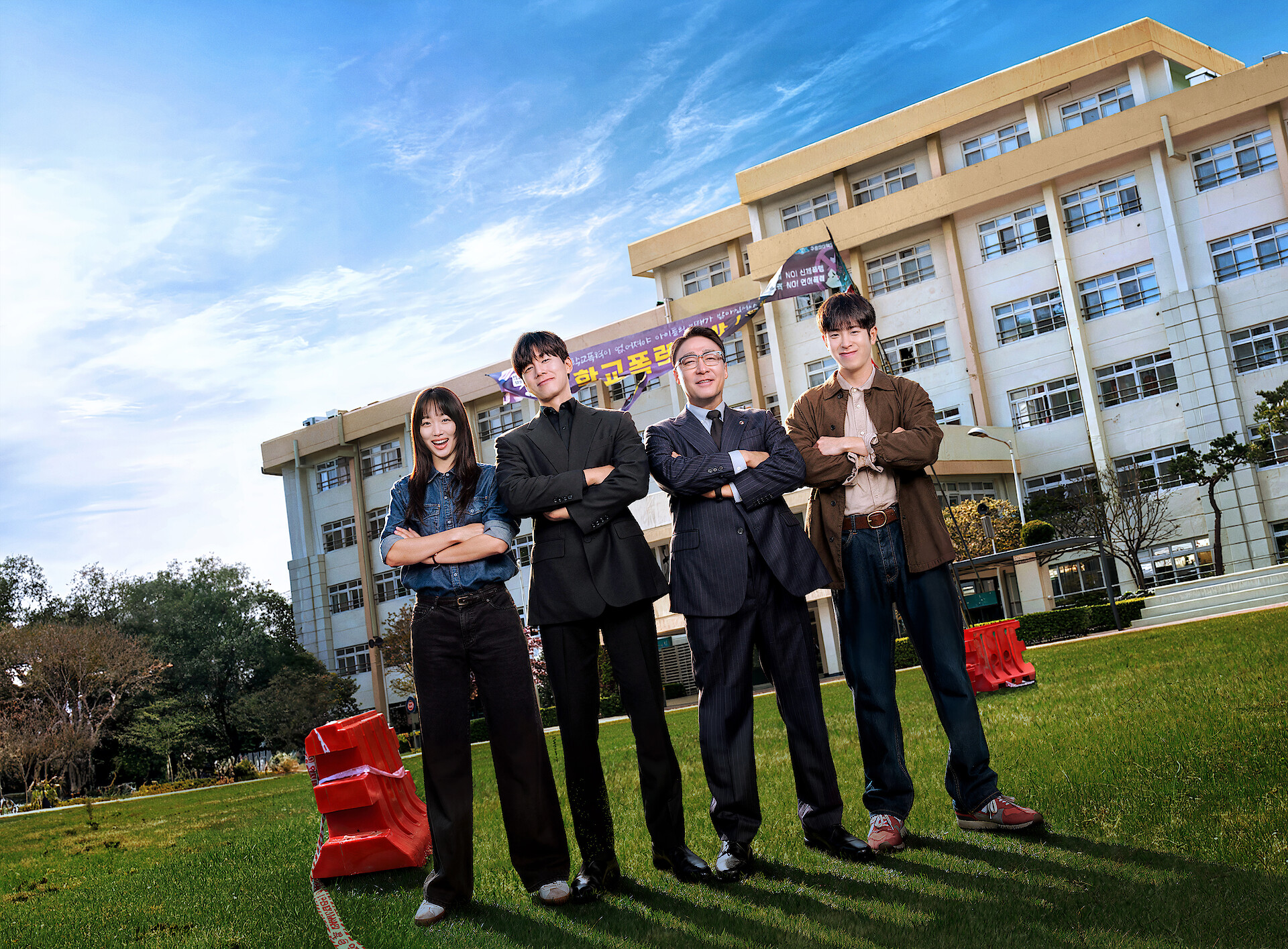
A Hard-Hitting Take on School Bullying: A Review
The drama opens with a disturbing and emotional scene. A boy wakes up, and we see brutal marks on his neck—clear evidence that something terrible has happened to him. He hesitates to go to school, unable to face what awaits him there. But the real question is not just what happened to him physically—it’s what he is going through mentally.
Despite his fear, he goes to school, only to encounter an even more horrifying situation. Another boy is about to jump off the school building. The entire school begins shouting one name—Park Dae-seok. It quickly becomes clear that Dae-seok is now the designated outcast. He has been severely bullied, humiliated to the extent that he was forced to go to every classroom and declare himself as the new outcast.
What is even more unsettling is the reaction—or rather, the lack of reaction—from the teachers. They remain silent, fearful of potential accusations related to child abuse or violations of human rights. Their inaction speaks volumes. And then, the inevitable happens—Dae-seok falls and dies.
The police arrive, carry out their routine, and leave. Life moves on. But nothing truly changes.
Soon, the role of the outcast is passed on. Now it is Gyeon-min, the previous outcast before Dae-seok. The cycle continues as if nothing happened. Even after a death, the system remains untouched. This is perhaps one of the most shocking aspects of the drama.
Watching this raises a serious question—does bullying in Korea really happen at such an extreme level? It feels difficult to believe, yet the fact that multiple Korean dramas—like The Glory and others—portray similar themes makes one wonder if there is some truth behind it. We also often hear about celebrities facing consequences or having their careers ruined due to past bullying allegations. This suggests that bullying might be more deeply rooted and widespread than one would initially assume.
Gyeon-min’s situation becomes increasingly tragic. He is forced to drink alcohol and is pushed to the brink, almost following the same path as Dae-seok. However, he lacks the final push—the heart to end his life. As a viewer, one naturally expects that someone will step in, that someone will question what is happening. But that hope seems distant at first.
Then enters Gwang-su, a character who prides himself on being an MMA fighter. Instead of helping, he becomes another tormentor, targeting Gyeon-min, who is already struggling just to survive. Gwang-su beats him severely, not out of necessity but to show off his so-called skills. In a disturbing moment, he even demands to be slapped by Gyeon-min, turning violence into a twisted form of entertainment.
But things take a sudden turn.
Instead of Gyeon-min retaliating, someone else steps in—a man who immediately stands out. He is handsome, calm, and carries a strong presence. At first glance, anyone would be drawn to him. This raises the question: Is he a savior? Is he the hero who will finally put an end to the bullying culture at Daehan High School?
As the episodes progress, his actions suggest that he might be exactly that. In a striking scene, he slaps Gwang-su for raising his voice against elders. What follows is both intense and somewhat ironic—Gwang-su, who earlier flaunted his MMA abilities, is later seen sweeping the floor after being overpowered. The shift in power dynamics is both satisfying and intriguing.
However, this intervention does not go unnoticed. Students record his actions and upload them on social media, labeling him as a “grim reaper” and even a “student abuser.” This introduces another layer to the story—how quickly public perception can be shaped and distorted.
Eventually, the school management steps in, and the man reveals his identity. He is Na Hwa-jin, an inspector assigned specifically to handle bullying cases in schools. His approach is unconventional. He believes that discipline, even if harsh, is a form of teaching—especially in a place where the system has completely failed. In his own words, he aims to correct a “trashy school” that remained silent even when a student died.
This leads to another critical question—how does a single officer have such authority? How can he act so freely, even resorting to physical methods, especially when dealing with students? This is where the drama begins to blur the lines between realism and fiction. It hints that there might be more to his role, possibly explored through flashbacks.
Moving into Episode 2, the narrative expands. It becomes evident that Na Hwa-jin does not operate in just one school. He moves from school to school, tackling different cases of bullying. In this episode, the setting shifts to a group of mechanical students. While the background and circumstances differ, the core issue remains the same—bullying persists in various forms.
The drama suggests the existence of a government-formed force designed to combat bullying, not just to protect students but also teachers. It hints at survey results indicating that even teachers are victims, sometimes facing extreme consequences, including violence from students. The situation is portrayed as deeply alarming, with student gangs allegedly linked to criminal activities such as drugs and organized crime.
However, this is also where the story starts to feel slightly unrealistic. The idea of a single man taking on such large-scale issues, often facing multiple attackers, begins to resemble an action-heavy narrative similar to something like Fast & Furious. While entertaining, it can feel exaggerated.
Episode 2, although not dragging, leans more towards fast-paced, somewhat unbelievable storytelling. This slightly reduces engagement, and it might tempt viewers to fast-forward. That said, curiosity about Na Hwa-jin’s true identity and background keeps the interest alive, leading into Episode 3.
Episode 3 brings a more relevant and impactful theme into focus—the role of social media. It highlights how online platforms can amplify bullying, especially when influencers manipulate public opinion. This adds a modern dimension to the narrative, showing that bullying is not confined to physical spaces but extends into the digital world as well.
At this point, another expectation arises—will there be a female lead? Or will the drama continue to focus solely on male characters and their dominance?
As the story progresses, a strong female character does appear—Han-rim. While she is portrayed as powerful and assertive, there is a slight disconnect between her appearance and her behavior. She comes across as soft in looks, which contrasts with her aggressive and intense demeanor. Additionally, her tendency to shout frequently can feel somewhat overdone and even a bit annoying at times. Her hairstyle also appears somewhat artificial, almost like a wig.
Despite these minor drawbacks, her performance is commendable. She adds value to the story and holds her ground in a narrative dominated by strong personalities. An interesting detail that stands out is her age—37 years old—which is quite surprising given her youthful appearance. It naturally leads to admiration (and a bit of jealousy) regarding how Korean actors maintain such looks. That’s why Korean skincare is highly regarded.
Another notable character is Deputy Director Bong Geun-dae. His personality provides a refreshing contrast to the otherwise intense storyline. He is shy, intelligent, and his interactions with Im Han-rim bring moments of light humor amidst the seriousness. These brief exchanges help balance the tone of the drama.
Overall, the drama delivers a compelling, action-driven narrative centered around bullying. It raises important questions about systemic failure, the role of authority, and the psychological impact on victims. At the same time, it takes creative liberties, sometimes leaning into exaggerated action sequences.
Is it worth watching?
Yes. If you are looking for a drama that focuses on action with a serious theme and minimal distractions, this is a good choice.
Is it worth watching all the episodes?
May be!
My Rating: 3.9/5
Will I rewatch it?
No.
Does it have romantic scenes?
No.
Can it be watched with children?
No.
Language: Korean
Availability: Netflix
Who should watch this?
Anyone who prefers action-driven dramas with little to no romance and is interested in intense, socially relevant themes.
Who should avoid this?
Children, and viewers who primarily enjoy romantic Korean dramas.
Image credits:Netflix
Related Links: Boyfriend on demand, Best dramas 2026, Perfect crown Summary, Reply 1988 Summary