
REVIEW:
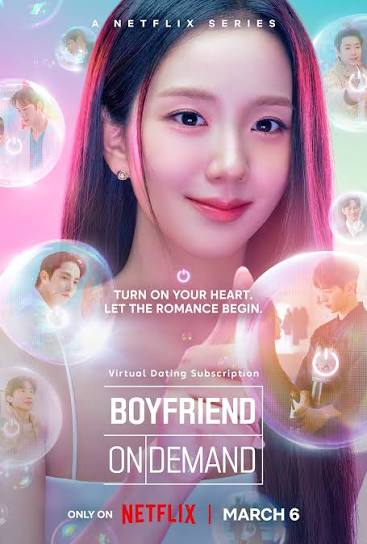
Boyfriend on Demand (2026), is a South Korean science fantasy romantic comedy directed by Kim Jung-sik and written by Namgung Do-young. Released on Netflix, the series stars Jisoo as Seo Mi-rae and Seo In-guk as Park Kyeong-nam / Gu Yeong-il. At first glance, it looks like one of those ambitious modern K-dramas trying to merge technology, romance, and emotional escapism into a single concept.
The premise immediately stands out: a subscription-based virtual boyfriend service where users can experience ideal romantic relationships through simulated “episodes.” These episodes are not just random fantasies—they are structured experiences where different users can subscribe and live through curated romantic scenarios. On paper, it sounds innovative, especially for viewers who enjoy experimental romance storytelling.
However, while the idea is strong, the execution feels uneven. As a long-time K-drama viewer since 2013, this drama feels like it borrows familiar romance patterns but fails to deliver the emotional weight or storytelling charm that Korean dramas are usually known for. Even though Netflix managed to generate strong viewership numbers, the series lacks the emotional identity and narrative depth that typically defines memorable K-dramas.
Overall, Boyfriend on Demand is a visually polished but emotionally inconsistent drama. It offers entertainment value mainly through its concept and cast but struggles to leave a lasting impression.
Overall Rating: 3/5
Plot Overview (Spoiler-Free)
The story follows Seo Mi-rae, a burnt-out webtoon producer who is mentally exhausted by her career and emotionally disconnected from real-life relationships. Seeking escape, she subscribes to a futuristic virtual dating service called “Boyfriend on Demand.”
This system allows users to enter immersive romantic simulations where they can select different “episodes,” each offering a unique boyfriend experience tailored to their emotional preferences. These experiences feel real within the user’s perception, creating an illusion of actual romantic relationships.
Mi-rae begins using the system as a form of emotional relief, but gradually becomes more invested in it than she expected. The virtual boyfriends are designed as ideal partners, and the system becomes addictive due to its emotional customization and immersive storytelling.
At the same time, Mi-rae works in a real-world office environment where she meets Park Kyeong-nam, a strict and emotionally reserved colleague. He appears distant at first but gradually becomes more involved in her life. The story builds tension around the contrast between artificial emotional satisfaction and real human connection.
The drama’s structure is heavily episodic, especially in the early stages, where each virtual boyfriend “episode” introduces a different romantic scenario. These episodes feel like mini romance films inside the larger story.
Cast and Performances
One of the strongest aspects of Boyfriend on Demand is its cast lineup, particularly the combination of main leads and special appearances. Seo In-guk delivers a controlled and charismatic performance as Park Kyeong-nam. His character is emotionally restrained but layered, and his subtle acting helps elevate otherwise simple scenes.
Jisoo, as Seo Mi-rae, portrays a relatable but emotionally exhausted character. She does well in lighter, conversational moments, but her emotional performance feels inconsistent in more intense narrative sections. The writing does not always support her character development, which limits her overall impact.
However, the biggest attraction is not just the main leads—it is the virtual boyfriend casting system. The drama features multiple high-profile Korean actors appearing as ideal romantic simulations. These include well-known names like Lee Soo-hyuk, Seo Kang-joon, Lee Jae-wook, and others, who each portray different “fantasy boyfriend” versions within individual episodes.
These cameo roles add novelty and excitement, making each episode feel like a premium anthology romance experience. However, despite the strong casting, many of these actors are underutilized, with their appearances limited to short, self-contained scenarios.
Story and Screenplay
The screenplay starts with a strong concept but gradually loses momentum. The idea of a subscription-based romantic simulation system is creative and relevant, especially in a modern digital context. The episodic boyfriend structure initially feels refreshing.
However, as the story progresses, repetition becomes noticeable. Many episodes follow similar emotional patterns, and the narrative fails to evolve the central concept beyond surface-level exploration.
The romance between Mi-rae and Kyeong-nam is developed slowly, but lacks consistent emotional buildup. While the early episodes are engaging, the second half becomes predictable and formula-driven. The drama often relies on familiar K-drama romance tropes without adding new depth or originality.
The virtual system itself, which should have been the core of the narrative, is not fully explored in terms of psychological or philosophical implications. Instead, it remains a storytelling device rather than a thematic focus.
Direction and Cinematography
Director Kim Jung-sik delivers a visually strong production. The cinematography is clean, modern, and aesthetically pleasing. The contrast between real-life scenes and virtual simulation worlds is well executed through lighting, color tones, and set design.
The virtual boyfriend episodes are especially visually impressive, often resembling high-budget romance films. Each simulation has its own tone and atmosphere, helping differentiate emotional experiences.
However, while the visuals are strong, they sometimes overshadow storytelling depth. The direction prioritizes aesthetic beauty over emotional or narrative complexity, which contributes to the overall imbalance of the series.
Soundtrack (OST)
The OST supports the emotional tone of the drama without becoming a standout element. It includes soft romantic ballads and atmospheric background tracks that enhance emotional scenes.
Artists like Doyoung (NCT), Choi Ye-na, and Fromis 9 contribute to the soundtrack, adding variety and emotional texture. However, no track becomes particularly iconic or memorable beyond the viewing experience.
The music does its job in maintaining mood but does not elevate the narrative significantly.
Strengths
The biggest strength of Boyfriend on Demand is its concept. The idea of a virtual boyfriend subscription system is unique and offers strong creative potential. It feels modern and relevant in today’s tech-driven storytelling landscape.
Another major strength is the visual presentation. The drama is consistently polished, with high production value and aesthetically pleasing romance sequences.
Seo In-guk’s performance is also a standout, providing emotional stability and strong screen presence throughout the series.
Finally, the cameo system featuring well-known actors adds excitement and variety, especially in the early episodes.
Weaknesses
Despite its strengths, the drama suffers from several key weaknesses. The most noticeable issue is underutilization of its cast. Many talented actors appear in the virtual boyfriend episodes but are not given enough screen time or narrative depth.
The storytelling becomes repetitive after the initial concept is introduced. Emotional beats start feeling predictable, and the drama fails to build meaningful progression in its later episodes.
Jisoo’s performance is inconsistent, especially in emotionally demanding scenes, which affects the overall emotional engagement of the story.
Most importantly, the drama lacks the emotional charisma that defines strong Korean romance storytelling. Even familiar romance K-drama tropes are executed in a way that feels flat rather than engaging.
What Makes It Different?
The defining feature of Boyfriend on Demand is its episodic virtual romance system. Each subscription unlocks a different boyfriend scenario, creating an anthology-style structure within a single narrative.
This allows the show to experiment with different romantic archetypes and fantasy situations. However, the concept is not deeply explored beyond surface-level entertainment.
The inclusion of high-profile actors as virtual boyfriend versions adds novelty, but does not significantly impact the main storyline.
Who Should Watch It?
This drama is best suited for viewers who enjoy visually appealing romance stories with attractive casts and light storytelling. Fans of Seo In-guk or cameo-heavy K-dramas will likely find it entertaining.
However, viewers expecting strong narrative depth, emotional intensity, or meaningful sci-fi exploration may find it underwhelming.
The first few episodes, especially, are worth watching for their novelty and cameo-driven romance structure.
Final Verdict
[SPOILER ALERT!!!]
As the story progresses, Mi-rae becomes increasingly emotionally attached to the virtual boyfriend system. She unknowingly begins to blur the boundaries between simulation and reality, treating programmed experiences as genuine emotional memories.
One of the key turning points occurs when she interacts with a virtual boyfriend played by Lee Soo-hyuk. In one emotional episode, she nearly shares a kiss with his character but disconnects the system just before it happens. This moment becomes surprisingly impactful for her, and she later regrets losing that experience, showing how deeply the simulation affects her emotions.
As the narrative unfolds, it is revealed that Park Kyeong-nam, her real-life colleague, closely resembles one of the ideal boyfriend templates within the system. This revelation shocks Mi-rae, as she realizes her emotional preferences may have been reflected in real life all along.
[SPOILER ALERT!!! CONTINUES]
Kyeong-nam eventually discovers Mi-rae’s involvement with the system and her emotional connection to virtual versions of him. This causes conflict between them, as he feels his identity has been fragmented into artificial simulations rather than being seen as a real person.
He becomes upset and emotionally distant, leading to a temporary separation. However, through confrontation and emotional honesty, the two eventually reconcile and choose to build a real relationship beyond the system.
Despite this resolution, the emotional payoff feels somewhat underwhelming due to earlier pacing issues and underdeveloped narrative buildup.
Ultimately, Boyfriend on Demand is a visually impressive but emotionally uneven drama. It starts with a promising concept but struggles to fully deliver on its potential.
While Seo In-guk’s performance and the early episodic structure are highlights, the series loses momentum due to repetition and lack of narrative depth. Even with a strong cast and Netflix-level production quality, it does not achieve the emotional resonance expected from a top-tier K-drama.
Final Rating: 3/5
It is worth watching in parts, especially the first half and cameo episodes, but overall it remains a missed opportunity despite its strong concept and star power.
Related Articles:
Arang and the Magistrate Review , Phantom Lawyer Korean Drama Summary